"I can live with doubt and uncertainty and not knowing. I think it is much more interesting to live not knowing than to have answers that might be wrong" (Richard Feynman)

Showing posts with label emic/etic. Show all posts

Tuesday, April 6, 2010

Bringing Beginner's Mind/Etic Research to Women in Islam

“In the beginner's mind there are many possibilities, but in the expert's mind there are few”

Shunryu Suzuki quotes (Japanese Zen priest, ?-1971)


Originally posted 3/31/2009 at 1:54pm

I said last week I'd send an email about our conversations last class. The group presenting on gender presented a few videos out-of-cultural-context without any intervention into the generalizing stereotypes that exist in our culture about 1) women in Islam and 2) female circumcision in Africa. These two topics are fraught with stereotypes, "evolutionary" bias (like they are behind the modern way things SHOULD be), and mere misinformation that is worse than the truths are for actual men and women who are Muslims in the majority of cases.

Here's a different view than what we saw last Thu in class.


I insist that everyone take a look at a great website I found on PBS called GLOBAL CONNECTIONS: The Middle East. The first question they delve into is "What factors determine the changing roles of women in Middle East and Islamic societies?
Some Americans believe that Muslim women are oppressed by their religion, forced to cover themselves completely, denied education and other basic rights. It is true that Muslim women, like women all over the world, have struggled against inequality and restrictive practices in education, work force participation, and family roles. Many of these oppressive practices, however, do not come from Islam itself, but are part of local cultural traditions. (To think about the difference between religion and culture, ask yourself if the high rate of domestic violence in the United States is related to Christianity, the predominant religion.)...


The Quran explicitly states that men and women are equal in the eyes of God. Furthermore, the Quran:

  • forbids female infanticide (practiced in pre-Islamic Arabia and other parts of the world)
  • instructs Muslims to educate daughters as well as sons
  • insists that women have the right to refuse a prospective husband
  • gives women rights if they are divorced by their husband
  • gives women the right to divorce in certain cases
  • gives women the right to own and inherit property (though in Sunni Islam they get only half of what men inherit. Men are expected to care for their mothers and any unmarried female relatives, and would, it is reasoned, need greater resources for this purpose.)
  • While polygyny is permissible, it is discouraged and on the whole practiced less frequently than imagined by Westerners. It is more frequent in the Gulf, including Saudi Arabia. Many Muslims cite the Quranic phrase "But treat them equally... and if you cannot, then one [wife] is better" and argue that monogamy is preferable, or even mandatory.

The Quran and the role of women

As the Islamic state and religion expanded, interpretations of the gender roles laid out in the Quran varied with different cultures. For example, some religious scholars in ninth- and 10th-century Iraq were prescribing more restrictive roles for women, while elite women in Islamic Spain were sometimes able to bend these rules and mix quite freely with men (see Walladah bint Mustakfi below).

Some contemporary women -- and men as well -- reject the limitations put on women and are reinterpreting the Quran from this perspective.

How do you bring beginner's mind to something that seems so strange, even shocking at first? What tools do you have to have to begin considering how to think like an anthropologist. Think about how Geertz had to learn how to see sculptures in jungles, paintings in deserts, and political order OUTSIDE of state political structures that we recognize as "normal" or "the way is should be."

We will discuss this in class this week and the coming weeks.

Tuesday, November 3, 2009

The Leech and the Earthworm

Originally posted 11/20/07
Marc Silver directed a documentary about indigneous people's views on genetic engineering. This is the title sequence based on a folktale. What do you think about the emic vs. etic view of such a tale? What assumptions come up for the outsider who is white, from a colonial nation, from the US, or for the native Australian seeing this tale in a film for the first time?

Check out Marc's cool website.
http://www.marcsilver.net/#

Friday, October 10, 2008

CLARIFYING Social Construct

I noticed a few of you have been using the idea of a social construct a bit too generally. Here is the definition again:

A social construction (social construct) is a concept or practice which may appear to be natural and obvious to those who accept it, but in reality is an invention or artifact of a particular culture or society. Social constructs are generally understood to be the by-products (often unintended or unconscious) of countless human choices rather than laws resulting from divine will or nature.

People never see social constructs from an emic point of view. The insider never can see it. Like the fish never sees the water or humans never think about air. It's taken for granted. The etic view, the participant observer, the outsider (even insiders can become outsiders to their own culture from travel, migration, going away to college, etc.) the begin to see how people in a culture accept the invention as natural and obvious.

Anthropologists use interviewing inside of participant-observation to "expose the way in which a particular belief has been shaped by social forces" (Writes philosopher Paul A. Boghossian in WHAT IS SOCIAL CONSTRUCTION? philosophy.fas.nyu.edu/docs/IO/1153/socialconstruction.pdf).

For instance, how did we/you learn the belief that North is up. One social force impacting that view was colonialism by the British Empire. They created a view through maps emphasizing the upper parts where they were located in their emic view. Reading importance from top to bottom is a social construction. Not all cultures read and have their views correlated that way. Others are equally valid in seeing things differently. "Another society, differing from us only in their social values [their learned ways of thinking, feeling, believing and behaving], would have arrived at a different and incompatible belief [or view]." Boghossian writes further:
There are certainly many things, and facts about them, that are socially constructed in the sense ... : money, citizenship and newspapers, for example. None of these things could have existed without society [or enculturation and acculturation]; and each of them could have been constructed differently had we so chosen

If a belief of ours were shown to be socially constructed ... it would follow that we could abandon it without fear of irrationality [the earth is flat; Muslims are evil; carbohydrates are bad for you; noticing skin color causes racism]

[I]f we have the belief not because there is adequate evidence in its favor but because having it subserves some contingent social purpose [Muslims are evil], then if we happen not to share the social purpose it subserves we ought to be free to reject it.

Much important work has been done ... most significantly, it seems to me, [on the] topics of gender and race. Simone de Beauvoir (The Second Sex, 1953) and other feminist scholars since, have illuminated the extent to which gender roles are not inevitable but are rather the product of social forces. Anthony Appiah (Color Conscious: The Political Morality of Race, 1996, with Amy Gutman) has been particularly forceful in demonstrating that nothing physical or biological corresponds to the racial categories that play a pervasive role in our social lives, that these categories owe their existence more to their social function [stratification of resources and wealth affecting our views of who has wealth, power and prestige] than they do to the scientific evidence.
To clarify and be sure you are clear about what a social construct is, tell me what this says to you. How did you have the idea before reading this and how has it changed? If you get it, you can recreate it in your own words and even give an example back to me as if its yours.

Sunday, March 23, 2008

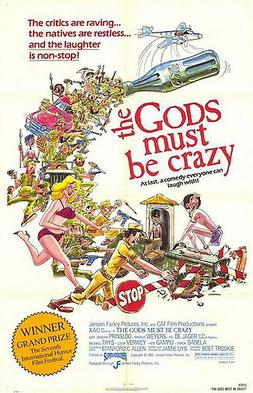
The Gods Must be Crazy

I just finished watching a film called "The Gods Must be Crazy."

Constantly, I was reminded of how those people we are so quick to call backward, are, in many ways, better off than we are. The introduction of the film provides a uniquely strange view and concept of our culture that we so often take for granted. We are a people who live by numbers: when the clock says 8.00, we wake up. When it gets to 9.00, we act busy, before settling back down at 12.00 to eat. The warm, National-Geographic-esque narration makes Xixo, a bushman and main character of the film, strikingly relatable to the viewer. In many ways, he begins to seem more "human" than we are.

Filled with clean, mild and genuine late 1970's comedy, the film in an enjoyable watch if you view it through the right lens; in my case, the anthropological. Head to your local Blockbuster or *cough* torrent site to get the film. You won't regret it.

Click here to get more info on this film.

Blog by Abraham Hedaya

Monday, February 11, 2008

Prof. G's Whiteness as Social Construct Slide Show

I know this exercise in creating a white museum (see previous post) has been difficult, uncomfortable and a bit baffling for many of you. As I reflect on how it is going, I am realizing that my presentation of it (as a professor who is not white) and the way I set you up (not as well as I would have liked in hindsight) was filled with troubling concerns. It looks like I am trying to entrap you into racist ideas and thinking. This much be disconcerting so early in the semester for many of you.

I promised this class would be a safe space to learn and grow in. I want you to be ready, willing and able to embrace and be empowered by ANY communication by the end of this course. Perhaps I've failed at bit at preparing you just yet. In any case, this is an important exercise that will set us up our conversations not about whiteness but about the nature of culture found in Chapter 3.

Yes, we need a definition of whiteness to complete this exercise though there are perhaps many we can come up with. That's the art of exploring the unknown, i.e., learning. To get to the unknown, we must empty ourselves of all we already know. Then discovering new things becomes available rather than replicating the past as if that's learning (sharing what you already think is known or true--that's just the first step). Additionally, we also need to define CULTURE to get at the heart of what this course in cultural anthropology is about and how it will become useful for you in the future. I gave you one definition--the learned ways of thinking, feeling, believing and behaving and now you've read about the value of working with a key cultural consultant (formerly called "informants" but the term evoked spying on your own culture/community).

So, I invite you to check out my emic slide show, my virtual white museum. I invite you and your group to create your own emic collaboration on whiteness as a slide show. That way we'll have 6 slide shows from the body of the class to compare. What different stories of whiteness can we tell or will the be the same? You game?? You can tell it from ANY perspective, from ANY point of view, from how far we come, what is no longer, from the view of minorities or from people considered white but view themselves as a particular ethnicity, or from religions, from sports, or from eye color and shape. Anything that tells a story about what we already know about whiteness. A local view of whiteness. We will explore and distinguish the difference between emic and etic in class. Prof. G

Wednesday, December 12, 2007

Last Call for You To Blog by Mon Dec 17th

I said AMNESTY ends this Thursday, but I will extend it to Monday December 17th. By posting 6 (six) responses to six different posts (either the original post or a comment by another student), you will fulfill your requirement to post on this blog for the semester.

I see all the posts (the program sends them to my email). I will not reply. This is a space for dialogue among you all and the blog will continue next term. So feel free to come visit.

BEFORE YOU POST, CONSIDER THE FOLLOWING:

Which, do you think, is more powerful?
  1. Reading the posts below and sharing whether you think it's right or wrong, or
  2. Reading the posts and considering what etic (or scientist's) view of the subject you can discover
Which is more useful to the other readers of a blog about anthropology?
  1. Sharing your view based on emic (insider) experience, sharing a firsthand account, or etic (scientist's) interpretations, or
  2. Sharing your personal opinion without asking if it has any bearing on the new insights and knowledge you gained from the Kottak chapters, our discussions or your newfound power as an experienced "mini" ethnographer.
You be the judge and let that inform your responses as you read back over the posts below.

In the upper right column of the blog,
you can click the arrow next to the dates
under BLOG ARCHIVE to view the previous topics.

Friday, September 28, 2007

TED TALK: Debunking third-world myths with the best stats you've ever seen


Thursday September 27th, in our Introduction to Cultural Anthro at Baruch College, we watched a TED TALK video (Technology Entertainment and Design) of Hans Gosling Debunking third-world myths with the best stats you've ever seen.

In the video he uses the acronym "OECD" that stands for:
Organisation for Economic Co-operation and Development, an international organization of those developed countries that accept the principles of representative democracy and a free market economy. For more see, http://en.wikipedia.org/wiki/OECD. Here's the video for those who missed class Thursday.


After the 4:05 section, one student asked a great question, which went over my head at the time. Gosling is debunking third-world myths but after viewing the video, the student said, they are still considered third-world myths after viewing the video. Gosling doesn't ask us to stop using "third world". I explained his intention but I had an epiphany about his question just after the student left class. We think we are trying to change things (change "third-world" to ???). But this video is about attacking people's PERCEPTIONS. Perceptions are the front-line of sustaining "social constructs" and this is why the study of cultural anthropology can be so meaningful with its emic and etic perspectives on the so-called Third World or on those who led us to using those terms in the first place (precursors to OECD??).

What do you think is the power of the video? What does it attack in your own preconceptions of the world not just the "third world"?